 CibilBazaar
Sign in to your account
Access your loan applications, track status, and get personalised offers.
Continue with Google
CibilBazaar
Access your loan applications, track status, and get personalised offers.
Continue with Google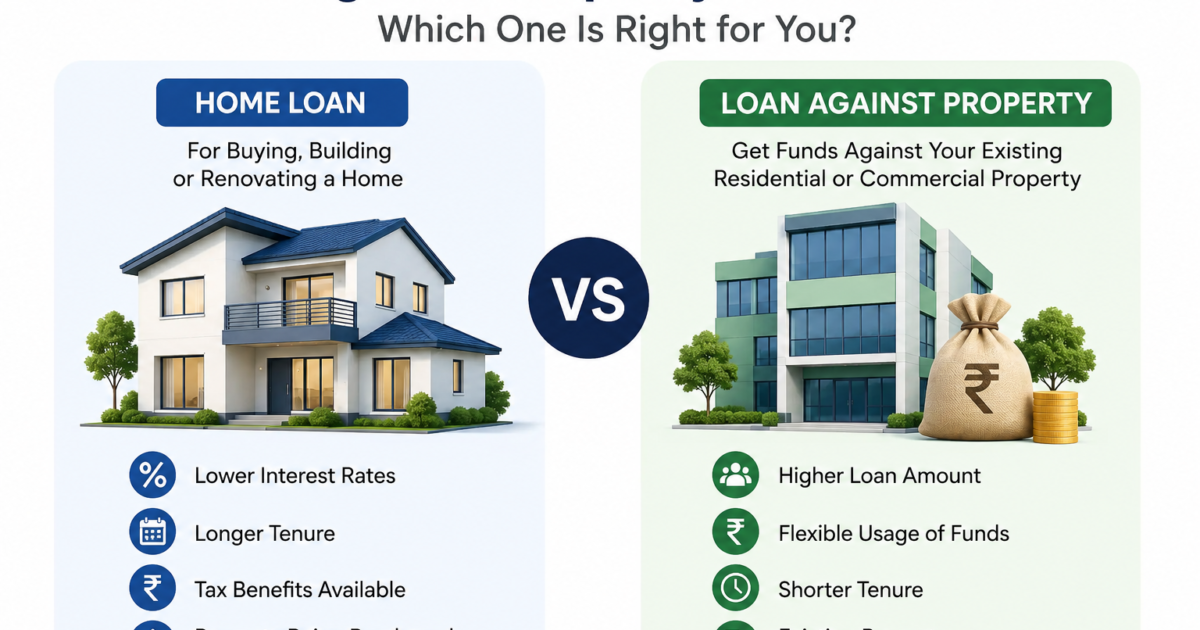
When you need a substantial amount of funding, a Home Loan and a Loan Against Property (LAP) are two common financing options. While both are secured loans backed by property, they serve very different financial purposes.
A home loan is primarily designed to help you purchase, construct, or renovate a residential property. A Loan Against Property, on the other hand, allows you to leverage a property you already own to access funds for a wider range of financial needs.
Understanding the differences between the two can help you choose the option that better aligns with your financial goals, repayment capacity, and purpose of borrowing.
A Home Loan is a secured loan offered for purchasing, constructing, or, depending on the lender and product, renovating a residential property.
The property being financed generally serves as security for the loan. The borrower repays the amount through monthly EMIs over an agreed tenure, and the lender’s security interest continues until the loan is repaid according to the terms of the agreement.
Home loans are generally associated with comparatively longer repayment tenures and may offer applicable tax benefits under prevailing income-tax provisions, subject to eligibility and the purpose of the loan.
A Loan Against Property (LAP) allows a property owner to mortgage an existing residential or commercial property to raise funds.
Unlike a home loan, the funds obtained through LAP can generally be used for a broader range of legitimate financial requirements, depending on the lender’s policy. These may include business expansion, education expenses, medical requirements, debt consolidation, or other personal and professional financial needs.
Because the borrower is leveraging an already-owned property, LAP can provide access to a substantial amount of funding without requiring the property to be sold.
The biggest difference is the purpose for which the funds can be used.
A home loan is specifically intended for housing-related requirements such as purchasing or constructing a home.
LAP offers considerably more flexibility because the funds can be used for various permitted personal or business requirements, subject to the lender’s terms.
The amount you can borrow depends on factors such as the property’s market value, your income, credit profile, existing financial obligations, and the lender’s internal policies.
Home loans can generally finance a significant portion of the property’s eligible value, while LAP typically offers a lower loan-to-value ratio because lenders assess the risk associated with lending against an existing property.
The exact amount varies from one lender and borrower to another.
Home loans generally carry lower interest rates than Loan Against Property, although the actual rate depends on the lender, borrower profile, credit score, property, loan amount, and prevailing market conditions.
LAP rates may be comparatively higher because of the greater flexibility in how the borrowed funds can be utilised.
Home loans can offer longer repayment tenures, potentially extending up to several decades depending on the lender and borrower eligibility.
LAP generally comes with a shorter tenure compared with a home loan.
A longer tenure can reduce the monthly EMI but may increase the total interest paid over the life of the loan. A shorter tenure can result in higher EMIs but may reduce the overall interest burden.
Home loans may provide tax benefits on eligible principal and interest repayments under applicable provisions of the Income-tax Act, subject to the borrower’s eligibility and the applicable tax regime.
Tax treatment for LAP is different. Depending on how the borrowed funds are used, certain interest-related deductions may be available in specific circumstances, particularly when the funds are used for eligible business or income-generating purposes.
Since tax rules can change, borrowers should verify their eligibility with a qualified tax professional.
Both loans involve financial and property-related checks.
A home loan typically requires verification of the borrower’s income, credit profile, property documents, and the legal and technical aspects of the property being purchased or constructed.
For LAP, lenders generally evaluate the existing property’s legal and technical status along with the borrower’s income, repayment capacity, and credit profile.
The actual processing time varies by lender and case complexity.
| Feature | Home Loan | Loan Against Property |
|---|---|---|
| Primary Purpose | Purchase/construct eligible residential property | Raise funds against an existing property |
| Property | Property being purchased/constructed generally serves as security | Existing residential/commercial property |
| Fund Usage | Primarily housing-related | Wider permitted personal/business requirements |
| Interest Rate | Generally lower | Generally higher |
| Tenure | Generally longer | Generally shorter |
| Loan-to-Value | Generally higher | Generally lower |
| Tax Benefits | Potentially available under applicable provisions | Depends on purpose and applicable tax provisions |
| Flexibility | Lower | Higher |
The right option depends primarily on why you need the money and what property you own.
A Home Loan and a Loan Against Property are not direct substitutes. Each is designed for a different financial requirement.
If your primary objective is to purchase or construct a home, a home loan is generally the more suitable financing option.
If you already own a property and need funds for a broader financial requirement, a Loan Against Property can provide greater flexibility by allowing you to unlock the value of your existing property.
Before choosing between the two, compare the interest rate, processing charges, loan-to-value ratio, tenure, EMI, total interest cost, foreclosure/part-prepayment terms, and your overall repayment capacity.
The smartest loan is ultimately the one that fits your financial objective without putting unnecessary pressure on your monthly cash flow.
Free check • No spam • Offers from 50+ lenders
Check Eligibility →